


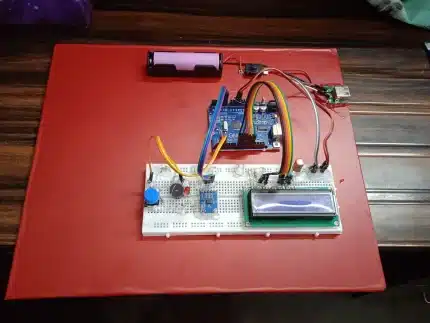

I am text block. Click edit button to change this text. Lorem ipsum dolor sit amet, consectetur adipiscing elit. Ut elit tellus, luctus nec ullamcorper mattis, pulvinar dapibus leo.
CAR PARKING SYSTEM
PROJECT REPORT
Arduino Nano Based Automatic Parking Management System
| Controller | Arduino Nano |
| Parking Capacity | 6 Parking Slots |
| Sensors | IR Sensors |
| Display & Gate | 20×4 LCD and Servo Motor Barrier |
- Introduction
The Car Parking System is an Arduino Nano based automatic parking management project designed to monitor and control a parking area having six individual parking slots. The main purpose of the system is to identify whether each parking slot is empty or occupied and to control vehicle entry according to the availability of parking space. IR sensors are installed at the individual parking slots to detect the presence of vehicles. Additional IR sensors are used at the entry area to detect a vehicle and confirm its movement through the entrance. A servo motor operates the barrier gate, while a 20×4 LCD displays the number of available spaces and the status of each parking slot. The system continuously updates the parking information in real time. When all six slots are occupied, the entrance barrier remains closed and no new vehicle is allowed to enter. When a vehicle leaves and a slot becomes available, the system updates the count and allows another vehicle to enter. This project demonstrates how a microcontroller, sensors, display and actuator can be combined to create a simple automated parking solution.
- Objectives of the Project
The primary objective of this project is to develop a simple, reliable and low-cost automatic parking monitoring system. The system is designed to achieve the following objectives:
- Monitor six parking slots individually using IR sensors.
- Detect whether each parking slot is empty or occupied.
- Display the real-time number of available parking spaces.
- Show the status of individual parking slots on a 20×4 LCD.
- Automatically control the entry barrier using a servo motor.
- Prevent entry when all six parking slots are occupied.
- Detect vehicle entry and exit using IR sensors placed at the entrance.
- Update parking availability immediately whenever a vehicle enters or leaves.
- Provide a simple and economical solution suitable for small parking areas.
- Hardware Components Used
| Component | Function |
| Arduino Nano | Acts as the main controller and processes signals from all IR sensors, controls the servo motor and updates the LCD. |
| IR Sensors – Parking Slots | Six IR sensors are used, one for each parking slot, to detect whether a vehicle is present. |
| IR Sensor – Entry Point | Detects a vehicle approaching the parking entrance. |
| IR Sensor – Entry Point 1 | Provides an additional detection point for confirming vehicle movement near the entrance and controlling the gate sequence. |
| Servo Motor | Operates the barrier gate. The servo rotates to open the gate when entry is permitted and closes it after the vehicle passes. |
| 20×4 LCD | Displays total parking capacity, available spaces and the empty/full status of individual slots. |
| 5V Power Supply | Provides the required power to the Arduino and other low-voltage components. |
| Connecting Wires and Breadboard | Used to connect the sensors, LCD, servo motor and Arduino during prototype development. |
- Working Principle
The Arduino Nano is the central control unit of the complete system. At startup, the Arduino initializes the IR sensors, servo motor and 20×4 LCD. The six parking-slot sensors are continuously checked to determine the current condition of each slot. Depending on the sensor output, the controller identifies a slot as empty or full. The number of empty slots is then calculated and shown on the LCD.
When a vehicle approaches the parking entrance, the entry IR sensor detects it. The Arduino checks the current parking availability before operating the barrier. If at least one parking slot is empty, the servo motor moves the barrier to the open position and the vehicle can enter. The additional entry-point IR sensor can be used to confirm the vehicle’s position or movement through the gate. After the vehicle passes, the barrier returns to the closed position.
If all six parking slots are occupied, the Arduino identifies that there is no available space. In this condition, the barrier remains closed and the vehicle is not allowed to enter from the outside. The LCD continuously informs the user about the parking condition. When a vehicle exits the parking area, the exit/entry detection sequence updates the corresponding parking status. The number of available spaces therefore increases immediately, and the system becomes ready to allow another vehicle when it approaches the entrance.
- Parking Slot Detection
Each of the six parking spaces has a dedicated IR sensor. An IR sensor works by transmitting infrared light and detecting the reflected signal from an object. When a car is positioned in front of the sensor, the sensor output changes and the Arduino interprets the change as an occupied slot. When the car is removed, the sensor returns to the empty condition. The Arduino reads all six sensors repeatedly so that the slot information remains updated in real time. This individual monitoring method makes it possible to display exactly which slots are occupied and which slots are available.
- Automatic Barrier Gate Control
The servo motor is used as the automatic barrier mechanism. Unlike a simple DC motor, a servo motor can be positioned at a specific angle, making it suitable for opening and closing a small parking barrier. When a vehicle is detected at the entrance and at least one parking slot is available, the Arduino sends the required control signal to the servo and the barrier opens. After the vehicle has passed the entrance detection area, the Arduino commands the servo to return the barrier to its closed position. When the parking area is full, the opening command is not given, so the gate remains closed.
- 20×4 LCD Display
The 20×4 LCD provides a clear user interface for the parking system. It can show the total number of parking slots, the number of currently available slots and the status of individual slots. For example, the display may show a total capacity of six slots and indicate which slots are empty and which are full. It can also show the current gate condition, such as OPEN or CLOSED. Because the information is updated by the Arduino continuously, the display provides real-time information to a driver or parking operator without requiring manual checking.
- Control Logic and Real-Time Update
The control program repeatedly reads the input state of every IR sensor. The six slot states are used to calculate the number of occupied and available spaces. The entrance sensors are then checked whenever a vehicle approaches. The gate is opened only when the parking availability condition permits entry. When a vehicle leaves, the relevant sensor state changes and the Arduino recalculates the available count. This continuous sensor-reading and decision-making process allows the parking counter and slot information to remain synchronized with the actual parking area.
- Advantages
- Automatic monitoring of six individual parking spaces.
- Real-time parking availability information.
- Automatic barrier gate operation.
- Prevents vehicle entry when the parking area is full.
- Individual slot status can be displayed on the LCD.
- Simple Arduino Nano based design that is easy to understand and modify.
- Low-cost components make the system suitable for educational and prototype applications.
- Reduces the need for manual checking of parking availability.
- Applications
The project can be used as a prototype for parking management in residential buildings, small offices, schools, colleges, shops, workshops and small commercial parking areas. The same basic concept can be expanded for larger parking facilities by increasing the number of sensors and using a more advanced controller or communication system. It can also be integrated with RFID, IoT connectivity, mobile applications or online monitoring in future versions.
- Limitations and Future Scope
The prototype is intended mainly for demonstration and small-scale parking management. IR sensor performance can be affected by sensor alignment, surface characteristics and environmental conditions. The basic system also does not include vehicle identification, payment processing or remote monitoring. These functions can be added in future development. An upgraded version could use an ESP32 or another network-enabled controller to send parking information to a mobile app or web dashboard. RFID or license-plate recognition could be added for vehicle identification, while LED indicators could be installed near each slot to guide drivers toward available spaces.
- Conclusion
The Arduino Nano based Car Parking System successfully demonstrates automatic monitoring and control of a six-slot parking area. IR sensors provide information about the occupancy of each parking space, while the Arduino processes these signals and maintains the parking status in real time. A servo motor is used to operate the entrance barrier, and the barrier is opened only when parking space is available. When all six slots are full, entry is prevented. The 20×4 LCD provides useful information about available spaces and individual slot conditions. The project is a practical example of an embedded control system in which sensors, a microcontroller, display and actuator work together to automate a real-world task. With additional communication and identification features, the same concept can be developed into a larger smart parking solution.


Reviews
There are no reviews yet.